The Baan Thip Guide
**Two Beloved Thai Noodles. Different Stories. Same Heart.**
Some Thai dishes are best understood before the first bite.
Khao Soi and Lad Nah may look completely different, but they share something important: both are dishes shaped by generations of cultural exchange, and both are at their best when they're eaten the way they were intended.
That's also why your Baan Thip takeout order may arrive with different components packaged separately. We aren't making things more complicated—we're trying to make sure your first bite tastes the way Thip intended it to.
## Khao Soi
**Northern Thai Curry Noodle**
### Where It Comes From
Khao Soi is one of the signature dishes of Northern Thailand and is especially associated with Chiang Mai and the historic Lanna region.
Its story reflects the crossroads that Northern Thailand once was. Yunnanese Chinese Muslim traders—often known as Chin Haw—traveled caravan routes connecting southern China, Myanmar and Northern Thailand. Over generations, their food traditions interacted with those of the communities along these routes, contributing to the family of noodle dishes from which Northern Thailand's Khao Soi developed.
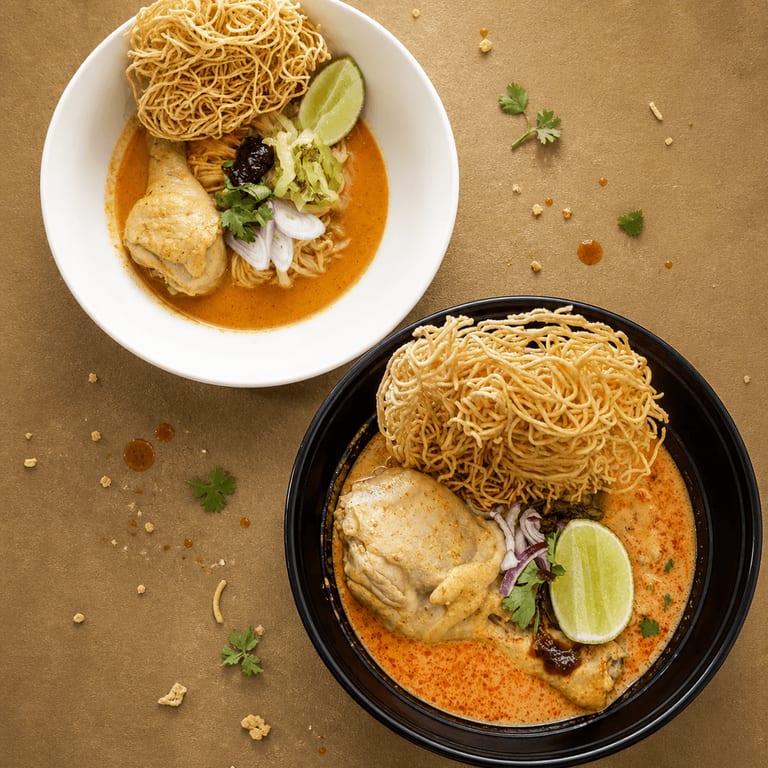
The result is something distinctly Northern Thai: tender noodles surrounded by fragrant curry and coconut broth, contrasted by a crown of crispy fried noodles and bright accompaniments.
It's a dish whose history can almost be tasted in the bowl.
### Why This Dish Matters
For many people in Northern Thailand, Khao Soi is comfort food.
But it also tells a larger story about the region itself—about migration, trade, neighboring cultures and the old Lanna Kingdom. Chiang Mai historically sat along important trading routes, and Chinese Muslim communities became part of its cultural heritage.
Today, Khao Soi has become one of Northern Thailand's most recognizable dishes.
And what makes it memorable isn't simply its curry. It's the contrast: soft noodles, crispy noodles, rich broth, tart pickled mustard greens, fresh shallots and lime. Each part has a purpose.
### Why Baan Thip Serves It Separately
If you've ordered our Khao Soi for takeout, you may notice that we don't simply put everything together in one container. That's intentional.
Once soft noodles sit in hot curry broth, they continue absorbing liquid. Meanwhile, the fried noodles that should provide that wonderful crunch begin to soften.
By the time you get home, two of the textures that make Khao Soi special can already be gone.
So we separate the components whenever possible. It takes a little more packaging and an extra step when you're ready to eat—but it means you get to finish the dish yourself at exactly the right moment.
### How to Enjoy Your Khao Soi
1. Heat the curry broth until steaming hot, if necessary.
2. Pour the broth over the soft noodles.
3. Add the crispy noodles on top.
4. Finish with fresh lime, pickled mustard greens and shallots to your taste.
5. Eat it right away—and try to get some soft noodles and crispy noodles together in your first few bites.
### A Note From Thip
“The magic of Khao Soi is enjoying soft noodles and crispy noodles together in the very first bite.”
That's the experience we're trying to preserve when we package your meal.